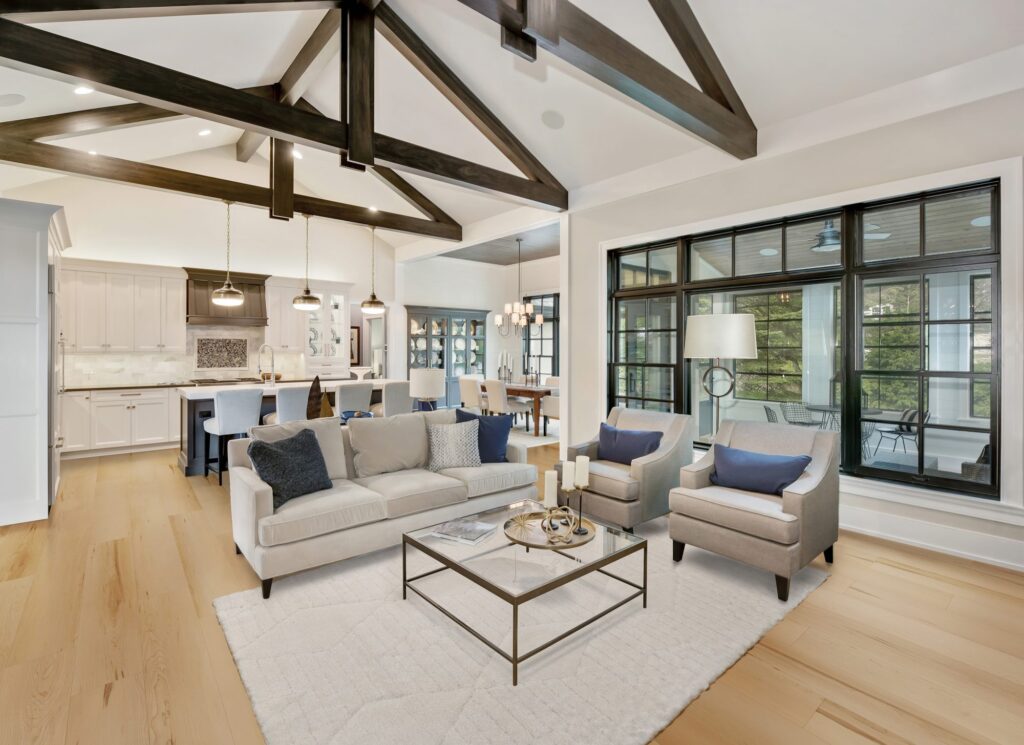
Luxury vinyl plank, or LVP, works for most of a Florida house. Laminate for the dry rooms where scratch resistance and the wood look matter most. That’s the short answer.
Most people comparing LVP vs laminate assume they’re close to the same product. They aren’t. LVP has a vinyl core. Laminate has a wood-fiber core. Nearly every difference between the two comes from that one fact, including the way each one fails. Both are wood-look floors people pick instead of hardwood, which is why anyone compares them in the first place.
What is the actual difference between LVP and laminate?
The core. LVP is built on vinyl, laminate is built on compressed wood fiber, and everything else about how they behave follows from that.
| LVP | Laminate | |
|---|---|---|
| Core material | Vinyl (PVC), often a rigid core | Compressed wood fiber, usually high-density fiberboard (HDF) |
| Water behavior | The plank doesn’t absorb water or swell | The core absorbs water and swells |
| Scratch resistance | Fair to good, depends on the wear layer | Good, the surface is harder |
| Dent and impact resistance | Dents under heavy point loads | Resists dents, chips at edges and joints |
| Feel and sound underfoot | Softer and quieter | Firmer and louder |
| Appearance | Convincing on better products | Often sharper print and texture |
| Best rooms | Kitchens, bathrooms, laundry, entries, whole house | Bedrooms, living rooms, offices, dry interior rooms |
Vinyl doesn’t absorb water and doesn’t swell. Wood fiber does both. Vinyl is softer, so it dents under a heavy load. Wood fiber is harder and denser at the surface, so it resists scratches but chips at an edge.
Assuming LVP and laminate are basically the same is the most common misunderstanding I hear about laminate flooring.
One more thing, because these names get mixed up. LVP is luxury vinyl plank. LVT is luxury vinyl tile, the same material cut in tile format. Sheet vinyl is a different product entirely, one continuous roll instead of planks. So “vinyl” on a sample could mean LVP, LVT, or sheet vinyl, and those are three different floors. Worth asking which one you’re being shown.
What does waterproof actually mean on a floor?
Waterproof describes the plank, not the room. An LVP plank genuinely doesn’t absorb water, and that matters. But a waterproof plank doesn’t make a waterproof floor.
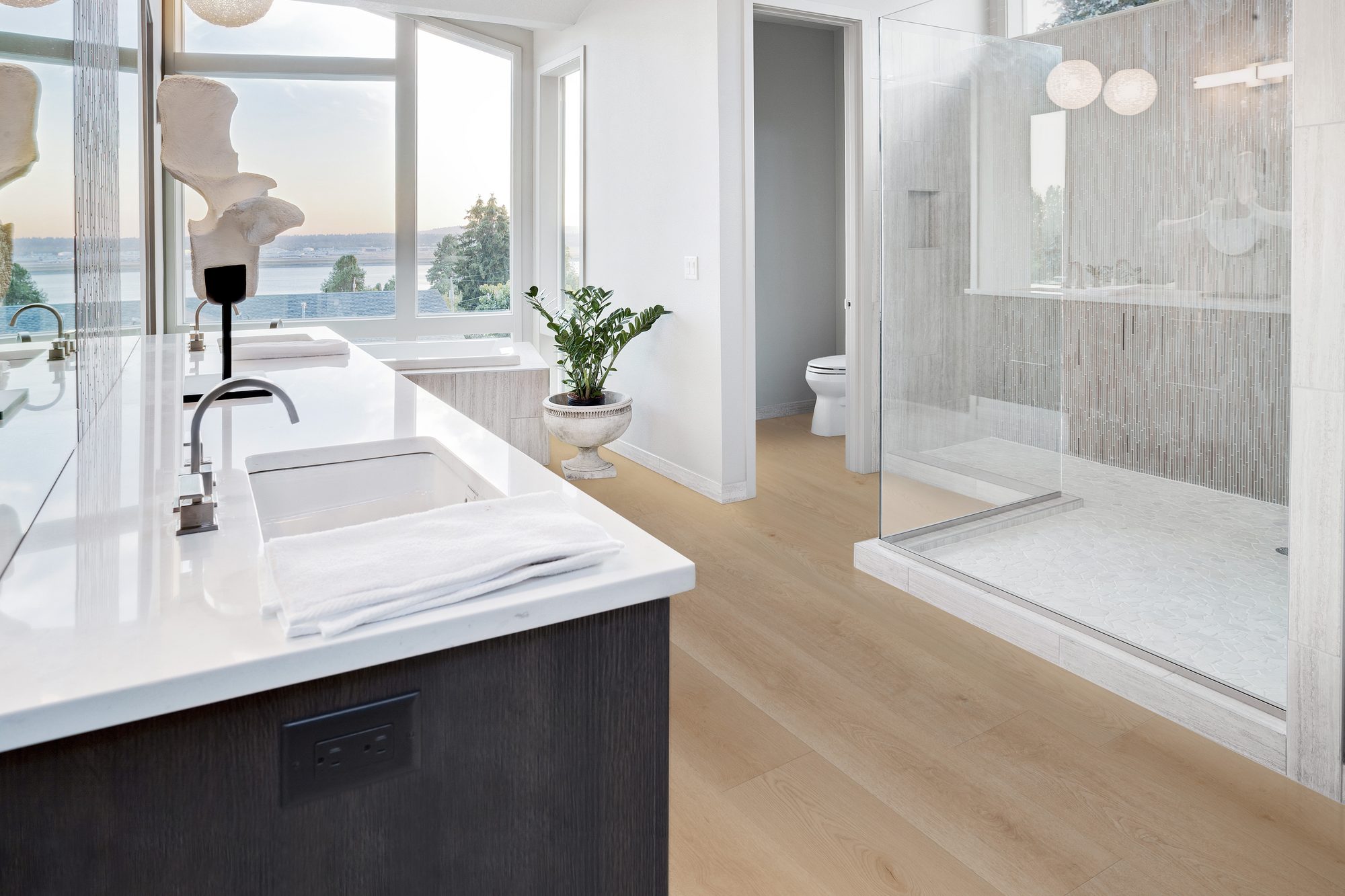
Water gets past the plank. It travels through seams and the perimeter gap to the subfloor, the edges, the walls, the baseboards, and the transitions. It can sit under the floor where nobody sees it, and that’s where the water damage happens. That’s why I plan LVP as a floor system, not a plank.
Laminate is different. Some laminate flooring is sold as water-resistant, which isn’t the same as waterproof, and it will handle a spill you wipe up promptly. That’s a short window, not a wet-area rating.
Some laminate is now sold as waterproof rather than water-resistant. Read that word the same way you’d read it on a vinyl plank: it describes the plank, and the core inside is still wood fiber. Standing water or repeated exposure swells that core, and a swollen core doesn’t go back.
Slab moisture is the single condition most likely to ruin LVP or laminate in Florida. Most floors here sit on a concrete slab, and a slab holds and releases moisture. In a humid climate that moisture moves up into whatever sits on top of it.
So flooring manufacturers require a slab moisture test, usually ASTM F2170, before a floating floor goes down over concrete. Floating means the planks lock together, not to the slab. The number the slab has to come in under is set by whoever makes the floor, not by the test. They also require a vapor barrier between the slab and a floating floor, and that requirement isn’t optional.
The F2170 test reads the moisture inside the slab, with probes set into small holes drilled in the concrete. Many installation guides also accept the older calcium chloride test, which only measures moisture leaving the surface. Either way, every slab should be tested, including a brand-new slab and one that looks dry.
Which one actually holds up better?
Neither one wins on durability outright. Laminate resists scratches better. LVP resists water better. They fail in opposite directions.
Laminate’s surface is harder, so it holds up better against dog claws, dragged furniture, and the grit that gets tracked in. LVP’s surface is softer, and on cheaper products with a thin wear layer it scratches more easily. If you have a dog, that split is the choice you’re making. Laminate takes the claws better, unless the LVP has a thick wear layer. LVP takes the water bowl and the accidents better.
Denting is LVP’s real weakness. Vinyl is flexible, so a heavy point load can leave a permanent impression: a refrigerator, a piano leg, a loaded bookcase. You can still put a refrigerator on LVP. Just know the feet can leave a dent that doesn’t come out. Laminate is more rigid and resists that kind of load, but it chips at an edge or a locking joint under a sharp impact.
Within each material, the quality range is wider than the gap between them. The wear layer on an LVP or the AC class on a laminate tells you more about lifespan than the material does. A cheap LVP and a good LVP are not the same floor.
The two failures aren’t equal, though. A scratched floor looks worn. A swollen core has to come out.
How do you read the specs on LVP and laminate?
The label on the box tells you almost nothing, and the two materials aren’t even rated on the same scale. LVP goes by wear layer thickness in mils, laminate by AC rating.
The wear layer is the clear protective layer on top of the printed image, measured in mils. A mil is a thousandth of an inch. Flooring suppliers split on where ordinary residential use starts, some at 12 mil and some higher. They agree on the busy household: most put the practical minimum at 20 mil for kids, pets, or heavy foot traffic.
On laminate, AC stands for abrasion class. It comes from a European standard, EN 13329, and runs from AC1 to AC6. AC3 covers all residential use, including high-traffic areas. AC4 gives you extra room for a busy house.
Abrasion is the only thing the number itself measures. A higher AC means the surface lasts longer under grit and traffic. It doesn’t tell you how well the locking joints will hold.
Rigid-core LVP is sold as SPC or WPC, and you’ll see those letters on the spec sheet. SPC is denser and resists dents better. WPC is softer and quieter underfoot.
Color is the last thing that decides whether an LVP holds up. The things that do are on the spec sheet.
Plank thickness is quoted in millimeters and wear layer in mils. They’re different numbers, and a thick plank with a thin wear layer isn’t a durable floor.
For a main living area, don’t go below 12 mil. The 6 to 8 mil products belong in guest rooms and other low-use spaces. Above 20 mil, the coating on top can matter as much as the extra thickness, so ask what the wear layer is finished with.
Which rooms suit LVP, and which suit laminate?
LVP anywhere water is realistic, because the plank is waterproof even when the room isn’t. Laminate only where water isn’t realistic.
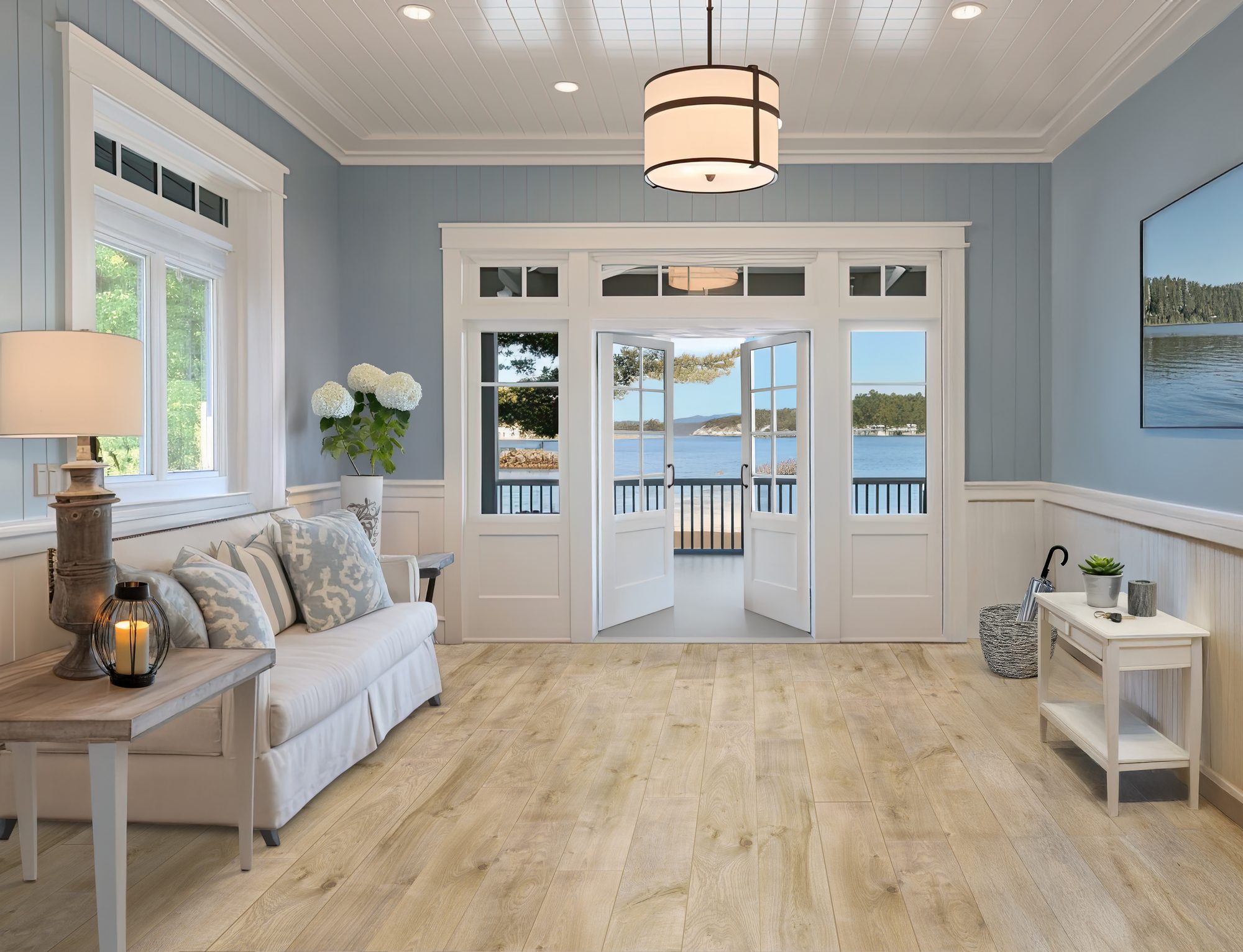
That puts LVP in kitchens, bathrooms, laundry rooms, entryways, mudrooms, and any room with an exterior door. It puts laminate flooring in bedrooms, living rooms, offices, and interior rooms that stay reliably dry. A bathroom isn’t one of them, no matter what the box says.
In a house where most rooms see some water, running LVP through the whole floor is often simpler than mixing materials. Every change of material means a transition, a place where two floors have to meet cleanly: a doorway, a stair, the edge of a tile floor. Those get resolved before work begins, not on installation day. Fewer of them means fewer places for the project to go wrong.
Across the U.S., luxury vinyl outsells laminate by a wide margin. Floor Covering News puts 2025 wholesale sales at about $7.4 billion for luxury vinyl and about $1.1 billion for laminate. Laminate fits best in a dry room over a wood subfloor, like an upstairs bedroom, where slab moisture isn’t a factor.
What does sun exposure do to each one?
Laminate flooring generally resists fading better. LVP is the one more likely to fade or move in strong direct sun, which surprises people who expect the vinyl product to win everything. The rooms with the most glass are usually the dry rooms, and that’s one more reason laminate earns them.
Fading comes first: the color shifts unevenly, so the floor by the window stops matching the floor in the middle of the room. Then expansion. Vinyl responds to heat by moving, and a floating vinyl floor in a hot sunroom can buckle if the expansion space wasn’t right.
Both effects are product specific. So check the manufacturer’s guidance on direct sun and sunroom installation before you buy. The warranty is written for that product, not for the category it falls into. Sun exposure is one of the conditions I review before we pick a product. A Florida room with glass on two or three sides gets hotter than the rooms next to it, and the manufacturer’s guidance has to cover that.
In the installation guide, look for what it says about direct sun, about rooms that aren’t climate controlled all year, and about the highest temperature the floor can take. Hot, sunny rooms often come with extra rules, like a wider expansion gap, a room size limit, or a glue-down installation with a heat-rated adhesive. Read the warranty too. Some cover only climate-controlled rooms and exclude sun and heat damage, even when the installation guide allows the room. Most guides also recommend blinds or drapes during peak sun.
Which one looks more realistic?
Laminate often has the sharper printed detail and the more convincing wood texture. Good LVP has closed most of that gap.
Both are a printed image under a protective layer. Realism comes down to print quality, texture, and how many different plank images are in the run. Cheap products of either kind repeat the same few images across the floor, and once you notice the repeat you can’t stop seeing it.
Two things to check. Ask how many unique plank faces the product has. Then look at whether the texture follows the printed wood grain instead of a generic surface pattern.
Neither one is hardwood, and neither will read exactly like it up close, but a good one reads right from standing height, in your light, across the whole room.
A single sample board can’t show you a repeat. Before you commit, lay out planks from several boxes together and watch for the same knot, streak, or dark spot turning up more than once. Manufacturer instructions also tell installers to mix planks from several cartons, which helps keep matching planks from landing side by side.
How does installation differ, and why does it matter?
Laminate is almost always a floating floor. LVP can be floating or glued down, and there’s no single right answer.
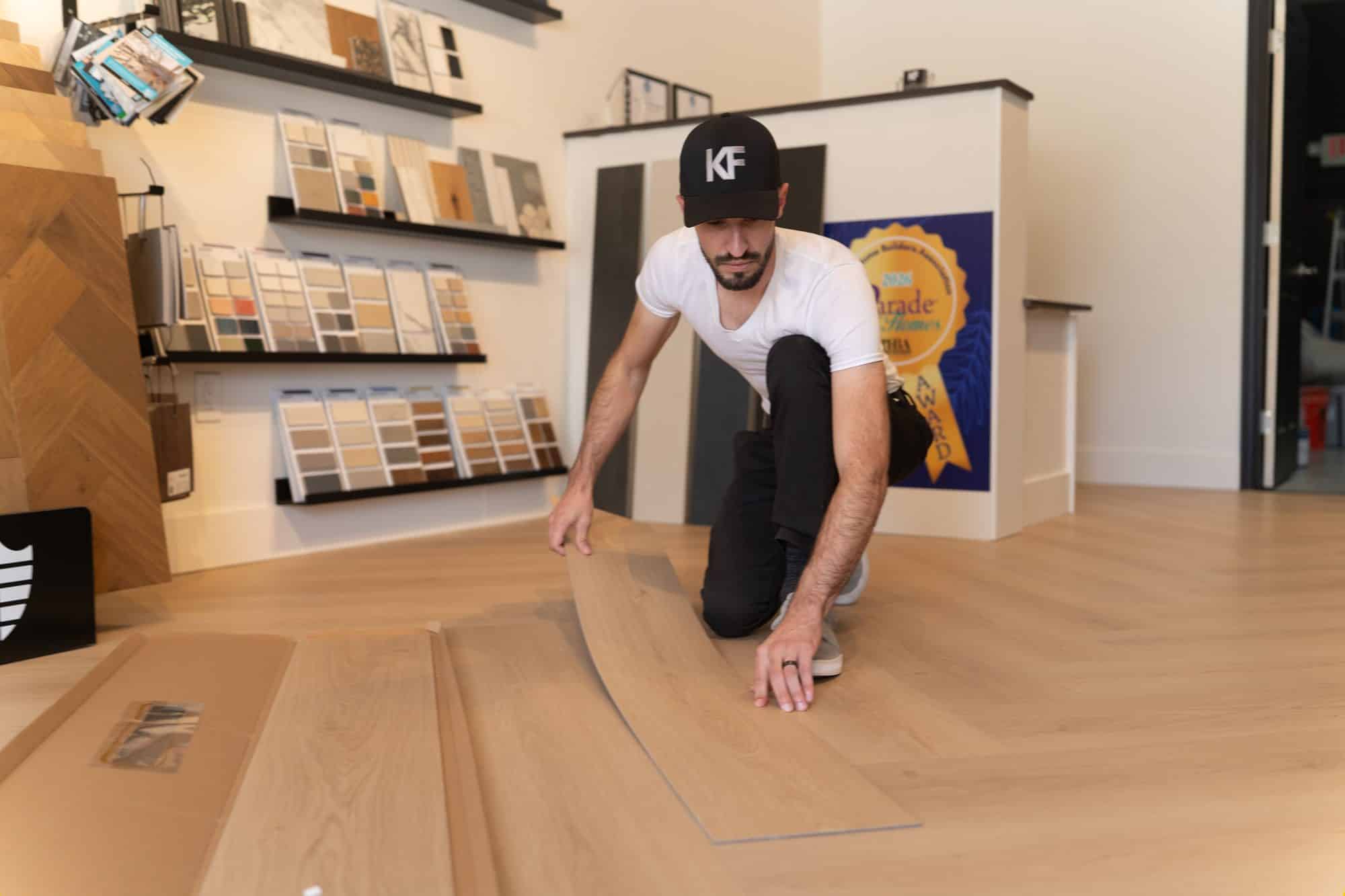
A floating floor sits as one piece over an underlayment, and the planks connect with a click-lock system. That one piece grows and shrinks a little with heat and humidity, so it needs expansion space at the walls, a flat enough subfloor, and compatible transitions.
A glue-down floor bonds directly to the subfloor, so it doesn’t move as one piece. That changes how it feels and sounds. Laminate rarely gets that choice, so the floating-floor rules apply to it either way.
What gets missed is usually the small stuff: door clearances, baseboards, and how the floor meets the next material. Those get documented, so by the time my team shows up, they’re following a plan, not making decisions on the fly.
What does each one cost?
Laminate costs less than LVP on material. Once installation is added, the two get closer. And within each material, the spread from the low end to the high end is wider than the difference between the materials.
These are national ranges, not my pricing. This Old House puts laminate material at $1 to $4 a square foot and LVP at $3 to $10, with installation on top of that. The labor ranges overlap: $4 to $8 for laminate, and for LVP the same $3 to $10 as the material. So the installed cost of the two can end up close. Where it lands depends on the install method and on what the subfloor needs first.
Inside the LVP range, the money goes to a thicker wear layer, a rigid core, better texture, and more unique plank faces. Those are the things that decide whether the floor still looks right years from now.
So the question isn’t which material costs less. It’s what the floor has to survive.
How do you clean and maintain each one?
LVP can take a damp mop. Laminate shouldn’t be wet mopped, even the water-resistant kind. Water sitting on a seam between laminate planks works into the wood-fiber core, which is the same failure as a spill left alone.
The rest of the routine is the same for both. Sweep or vacuum regularly, because grit is what actually scratches a floor. Wipe up spills promptly. With laminate flooring, promptly means right away. Use a cleaner the manufacturer approves rather than whatever is under the sink.
Start your plan with Kyler
Picking between the two materials is the easy part. The harder part is matching the product to your space, the slab underneath it, and how the floor will be installed. That’s the work that happens before anything gets ordered. If you’re in Palm Coast, Flagler County, or the Hammock, let’s talk about your project. Read how the planning process works, or come sit down with me at the studio.