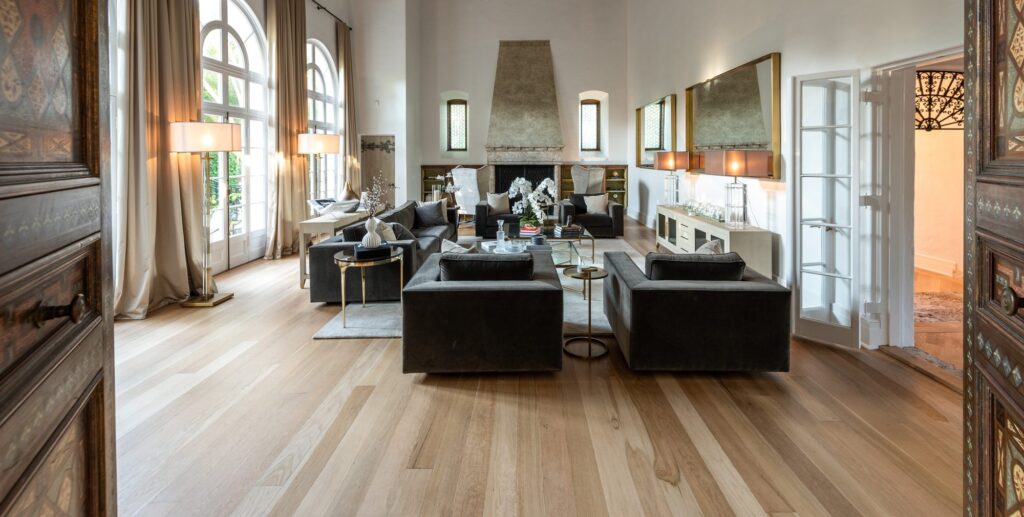
Engineered hardwood and solid hardwood are both real wood. The surface is the same material either way. What decides between them isn’t the wood. It’s what the floor is being built on.
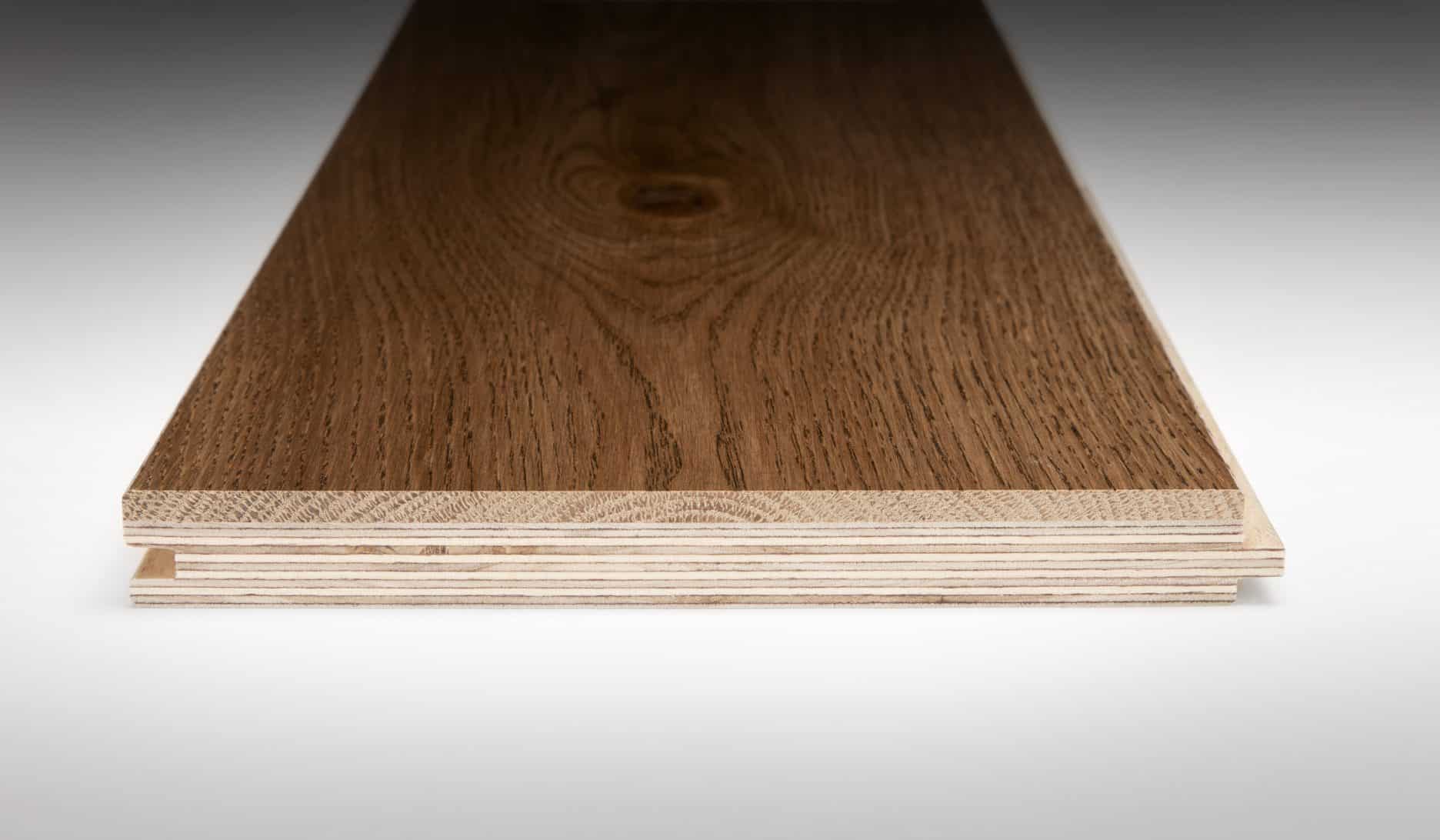
Solid hardwood is one piece of wood all the way through the plank. Engineered hardwood is a real hardwood top layer bonded to a layered core underneath. That’s the whole construction difference, and on its own it decides nothing.
The slab does. Most homes in Florida sit on a concrete slab, and that one fact changes what each material needs before it can go down.
If you’ve been reading comparisons for a few days and they all sound alike, this page settles something narrower: which one your project can actually take.
Is engineered hardwood real wood?
Yes. Engineered hardwood flooring is real wood. The top of every plank is solid sawn hardwood, the same material as a solid plank. The trade calls that top layer the wear layer, because it’s the wood you walk on.
The core sits under the wear layer, bonded to it. It’s layered plywood or high-density fiberboard, called HDF. The core is what gives an engineered plank its dimensional stability, which is the trade term for how little a plank moves as humidity changes. That’s why an engineered plank is less likely to cup or warp than a single piece of wood.
Laminate is the product people confuse with engineered wood, and it has no real wood surface at all. It’s a printed image under a protective layer, a different product entirely.
Once installed, most people can’t tell engineered and solid apart by looking, because the surface is the same wood either way. The only visible difference is at the plank edge, where the layers show.
Can you install hardwood floors on a concrete slab?
Yes. Both engineered and solid hardwood can go over a concrete slab, but the slab sets the terms, and the two meet those terms differently.
Most homes in Palm Coast, Bunnell, Flagler County, and the Hammock are built slab on grade, meaning the concrete slab is the floor structure.
Before any wood floor goes over concrete, the slab has to be:
- Dry enough, by test. The National Wood Flooring Association, or NWFA, sets a limit for two accepted tests. An in-slab probe test, ASTM F2170, has to read 80 percent relative humidity or lower. A calcium chloride test, ASTM F1869, has to read 3 pounds per 1,000 square feet per 24 hours or lower. Every test location has to pass, not the average. Manufacturers can set stricter limits.
- Flat enough. Glue and wood both need a flat surface, so high and low spots get corrected first.
- Free of any moisture problem, not just covered over. No wood floor fixes a wet slab. A moisture problem gets solved first or the floor fails, and a different product doesn’t change that.
Engineered hardwood can be glued directly to a slab that passes. Its layered core holds its dimensions through humidity swings, so it can sit on concrete without a subfloor.
Solid hardwood is normally nailed or stapled to a wood subfloor, and concrete gives it nothing to fasten to. The established NWFA route for solid wood over concrete is to build a plywood subfloor on the slab. A vapor retarder, usually a plastic film that blocks slab moisture, always goes underneath it.
A built-up subfloor raises the finished floor height. That changes door clearances, transitions, and cabinet and appliance heights. A few manufacturers allow direct glue down of their own solid product, but that’s their call, not general practice.
On a slab that passes its moisture test, engineered is the more direct path to a real wood floor. Solid is possible by an established method, but it’s a bigger project with real consequences for the rest of the space.
What are the real disadvantages of engineered hardwood?
An entry-level engineered hardwood floor can’t be sanded and refinished, ever. Standing water still damages it, and the label tells you almost nothing about what you’re getting. Those are the real disadvantages.
First, the wear layer, the wood on top of the plank, is too thin to sand on an entry-level floor. At 1.2mm it sits under the 2.5mm minimum the National Wood Flooring Association sets for sanding, so that floor is never refinished, only recoated, which is a fresh coat of finish over the top.
Second, water resistant isn’t waterproof. Some engineered products are sold as water resistant, and that describes a spill wiped up promptly. Standing water can damage engineered wood, and neither engineered nor solid hardwood should be installed in areas regularly exposed to water.
Third, the label tells you almost nothing. Two engineered products that look identical on a sample board can perform very differently.
Engineered wood flooring can still expand and contract. While it’s more dimensionally stable than solid hardwood, it isn’t completely resistant to movement. Cupping, gapping, and adhesive failure all happen when slab moisture or flatness isn’t dealt with before installation.
In Florida, with year-round humidity outside and constant air conditioning inside, the floor lives in whatever conditions the house holds. The National Wood Flooring Association puts the acceptable range at 30 to 50 percent relative humidity, all year.
These are mostly specification problems, not category problems. A thin engineered floor has hard limits. A well-specified one doesn’t have the same limits.
Can engineered hardwood be refinished?
It depends entirely on how thick the wear layer is, and nothing else on the spec sheet answers the question. The wear layer is the solid wood on top of an engineered plank, measured in millimeters. Total plank thickness doesn’t answer it.
The National Wood Flooring Association publishes a 2.5mm sanding threshold, and below it a floor shouldn’t be sanded. A single full refinishing pass removes roughly 0.8mm of wood. A heavier correction for deep scratches or cupping removes closer to 1.6mm. Here’s what the trade generally expects at each thickness:
- 1.2mm. Can’t be sanded. Recoat only. The entry-level tier, and a common one.
- 2mm. Below the threshold. Not a realistic candidate for a full sand.
- 3mm. Roughly two to three passes.
- 4mm and up. Roughly three to five passes.
- 6mm. The longest refinishing life sold in the category, roughly four passes.
Recoating is different from refinishing. A recoat adds a new finish layer over the existing surface without sanding into the wood, and it works on floors that can’t be sanded.
A solid hardwood floor can typically take sanding and refinishing up to about 10 times over its lifespan, depending on how much comes off each time. That’s its clearest advantage over engineered.
The practical question is how many refinishes a floor will really need. A busy floor might come due every 7 to 10 years. A lightly used one goes much longer.
Wear layer thickness decides how long the floor lasts, not just whether it can be sanded. A 3mm floor gets a couple of refinishes, and then it’s finish and recoats from there. A 1.2mm floor gets none, so its life is the life of its finish and whatever recoats it takes.
What separates a good engineered floor from a bad one?
Engineered versus solid isn’t the decision. The specification is. Two engineered hardwood floors can differ more than engineered differs from solid.
Three specifications decide it:
- Wear layer thickness, in millimeters. The wear layer is the solid wood on top of the plank. It matters most because it sets whether the floor can ever be sanded, and most buyers never ask about it. The industry threshold is 2.5mm, the minimum the National Wood Flooring Association sets for a factory-finished engineered floor to count as refinishable.
- Core material. Engineered cores are typically layered plywood or high-density fiberboard, called HDF. A plywood core is generally the more stable choice where moisture varies.
- Total plank thickness. Most engineered planks run about 10mm to 20mm thick. That affects how the floor feels underfoot and how it meets the flooring next to it. It doesn’t determine refinishing life. The wear layer does.
Words like premium or heavy duty on a spec sheet mean nothing. The millimeter figure is the fact.
Cost follows the specification too. The gap between a thin engineered floor and a well-built one is larger than the gap between the engineered and solid categories, so the meaningful question isn’t which category costs more. It’s what a given floor is specified to do.
A well-made engineered floor is a better outcome than an entry-level solid floor installed in conditions it can’t handle.
At Kirkpatrick Floors we review construction type, plank width, slab conditions, moisture, acclimation, installation method, stairs, and environmental control before a board is ordered. That’s the material selection step.
Ask three questions about any product. How thick is the wear layer, in millimeters? What is the core made of? And what does the manufacturer allow over concrete?
Will it hold up to kids, dogs, and daily life?
Whether a floor dents comes down to the wood species and the finish, not whether the plank is engineered or solid. A white oak engineered floor and a white oak solid floor have the same surface hardness, because the surface is the same wood. Durability isn’t a category question.
Kids and dogs don’t change the answer. They just find the soft spots faster. Claw marks and dropped-toy dents come down to the species and the finish, same as any other wear.
The Janka scale measures how much force a wood takes before it dents, and higher is harder. Red oak, at 1,290, is the industry benchmark.
- Hickory: 1,820, one of the hardest domestic species
- Hard maple: 1,450
- White oak: 1,360
- Red oak: 1,290
- Walnut: 1,010
- American cherry: about 950
- Pine: about 380 to 870
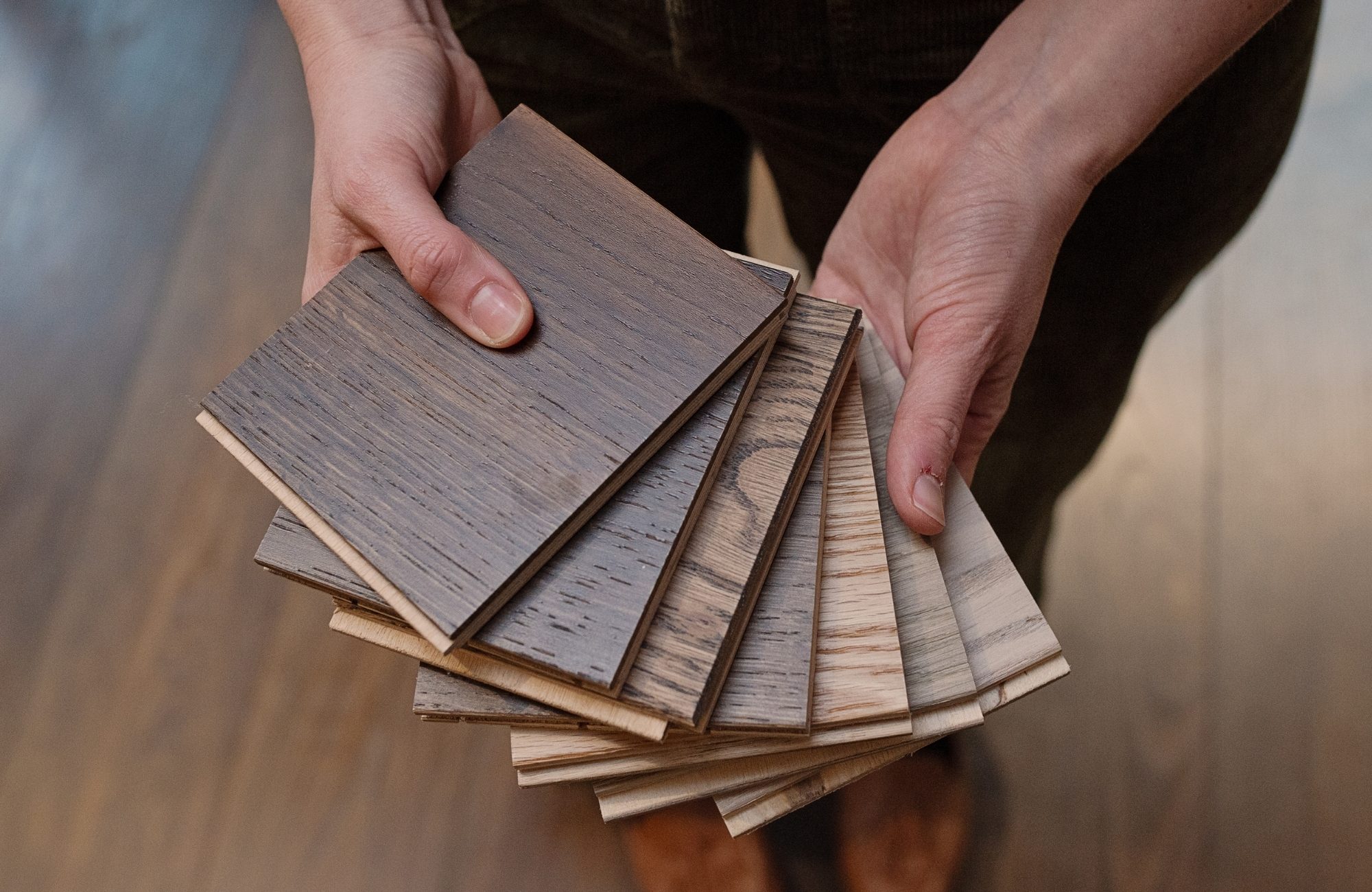
Real wood shows wear. Scratches, dents, and fading are normal, and they’re part of owning a wood floor. Wire-brushed and hand-scraped textures hide daily wear better than a smooth, glossy finish.
Neither material belongs in a full bathroom, a laundry room prone to leaks, or an entry with no protection from standing water. Kitchens are generally fine for either, as long as spills get wiped up.
How is each one installed?
There are three ways to install a wood floor: glue down, floating, and nail down. The product and the site conditions decide which one gets used, not preference.
- Glue down bonds the plank directly to the substrate, the surface under the floor. It’s the usual method for engineered hardwood over a slab. It needs substrate prep, the right adhesive, a passing slab moisture test, and a clean surface.
- Floating means the planks lock to each other and aren’t fastened to the substrate. Solid wood floors aren’t floated, so it’s engineered only. It needs flatness, expansion space at the edges, and compatible transitions.
- Nail down fastens the plank into a wood subfloor. It’s the standard method for solid hardwood, so over a slab the subfloor gets built first.
Acclimation means letting the flooring sit in the space until its moisture content balances with the air, so it doesn’t cup, crown, or gap later. The National Wood Flooring Association, or NWFA, doesn’t set a number of days. Many factory-finished engineered products follow the manufacturer’s instructions, and some need no acclimation at all. The real standard is a moisture meter reading, not a calendar.
Wide planks move more, and NWFA’s own numbers show how much: a 5 inch plank moves more than twice as much as a 2 1/4 inch strip.
NWFA also wants the space held at 30 to 50 percent relative humidity and 60 to 80 degrees for at least 5 days before the flooring arrives. In Florida, that means the air conditioning is already running, not switched on the day of delivery.
All of it gets decided before the material is ordered, not on installation day. That’s the planning process.
Let’s talk about which flooring is best for your space
The right answer depends on the slab, the product specification, and how the space gets used. We look at all three together before anything is ordered. If you’re choosing between engineered and solid hardwood, let’s talk about your project. Start with a consultation, a plan review, or a visit to the studio to sit down with me.